weewx-skyfield — The drop-in upgrade for WeeWX’s almanac
The drop-in upgrade for WeeWX’s almanac — Skyfield-powered $almanac tags, stars, satellites, comets, eclipses, and a planetarium-style Sky page.
View on GitHub Download weewx-skyfield.zip Report an issue
weewx-skyfield replaces WeeWX’s built-in almanac (PyEphem or weeutil) for report generation. Report tags such as $almanac.sunrise, $almanac.moon.transit, $almanac(horizon=-6).sun(use_center=1).rise and $almanac.next_full_moon (as used, for example, in the Seasons skin’s Celestial page) are computed with Skyfield and JPL’s DE421 ephemeris, which is installed with the extension — much more accurate values than PyEphem, which is deprecated by its own author in favor of Skyfield.
No skin changes are needed: the extension answers the same $almanac tags as the built-in almanac. Install it, restart WeeWX, and every report generated from then on uses Skyfield values.
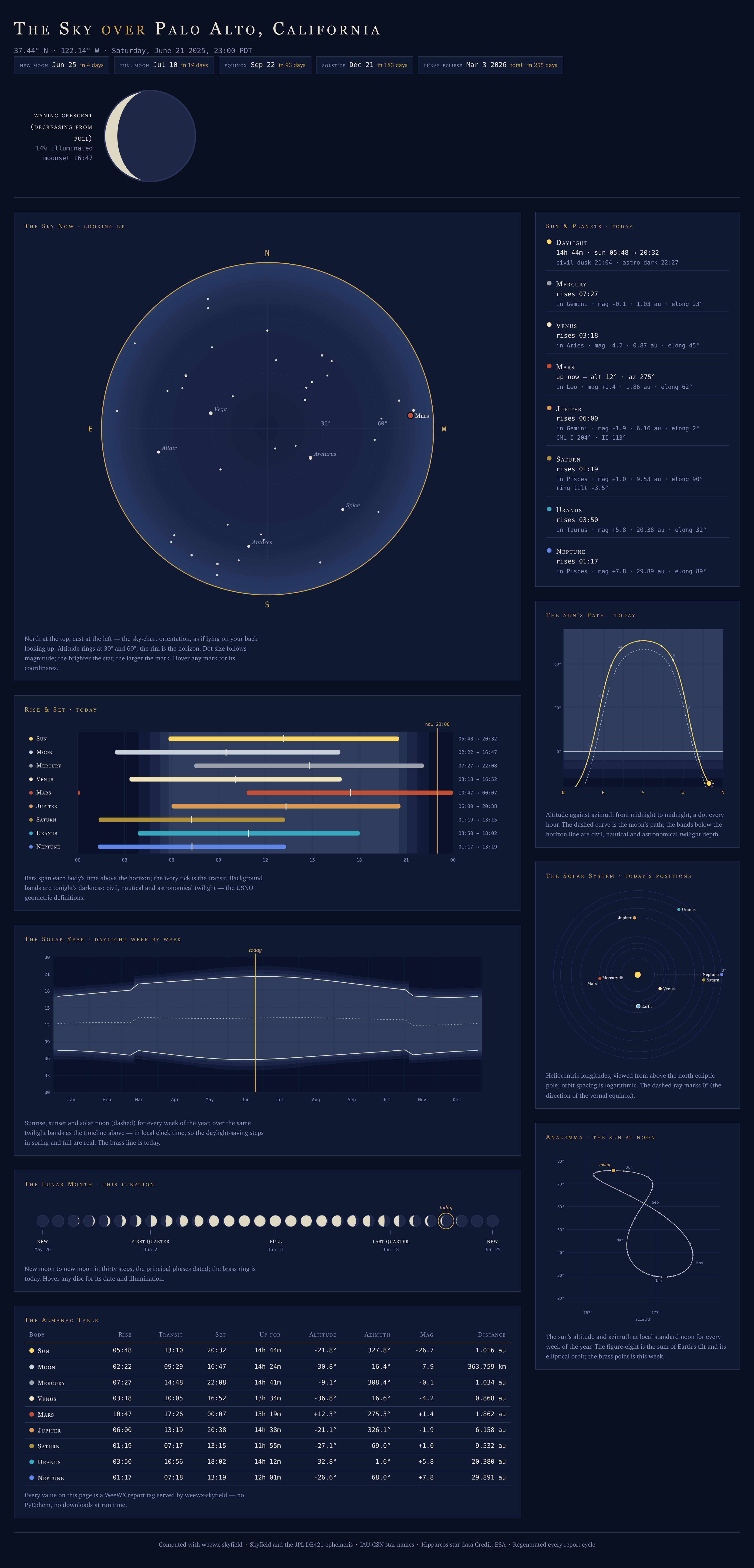
Installing the extension also installs The Sky, pictured below — a planetarium-style page drawn entirely from your station’s own latitude, longitude and elevation, published at <HTML_ROOT>/skyfield/index.html and regenerated with live values every report cycle. It is a showcase for what the almanac now knows: the sky above you right now, today’s rise and set times, the year’s arc of the sun, the current lunation, the next satellite pass. Nothing on it is fetched from beyond the page’s own directory — self-contained HTML and inline SVG, with a stylesheet and a few lines of script beside it — and every panel on it can be dropped into a skin of your own.
Tour the Sky page · embed its panels
Highlights
- Every standard tag, computed natively. Rise/set/transit with custom horizons and
use_center, positions, magnitudes, phases, equinoxes, solstices and moon phases for the sun, the moon and all planets (plus Pluto) — PyEphem is not required for any tag used by WeeWX’s standard skins. See the almanac tag reference. - All 118,218 Hipparcos stars, bundled.
$almanac.rigel.mag,$almanac.polaris.circumpolar— the IAU Catalog of Star Names plus PyEphem’s names for backward compatibility — and, as of 2.0, the complete Hipparcos catalog ships with the extension, so any star answers as$almanac.hip_57939, nothing to download. - Satellites — new in 2.0: track any satellite, by NORAD catalog number, with the ISS and Tiangong configured out of the box.
$almanac.iss.next_visible_passsays when to step outside and watch the ISS cross your sky — when it appears, how high it peaks, when it disappears — with orbital elements kept fresh automatically (one switch turns the fetching off). See the satellite tags. - Comets — new in 2.1: any comet the Minor Planet Center tracks, added to
weewx.confby designation, with Halley and Hale-Bopp configured out of the box. Each serves the full planet-style tag surface ($almanac.halley.rise,.mag,.perihelion) and rides the Sky page — a tailed diamond on the dome, a marker in the orrery — with elements kept fresh automatically, the satellites’ way (one switch turns the fetching off). See the comet tags. - Meteor showers, supermoons, the equation of time — also new in 2.1:
$almanac.next_meteor_showercounts down to a peak computed from the sun’s ecliptic longitude (the radiant marked on the dome while a shower is active); moon perigee/apogee and$almanac.next_supermoonbring the supermoon rule into the almanac, with Earth’s perihelion and aphelion beside them; and solar time and the equation of time get tags and a chart panel. See the meteor shower tags. - Eclipses and constellations — tag families with no PyEphem counterpart at all:
$almanac.next_eclipsefinds the next eclipse visible from your station, and every body reports the constellation it stands in ($almanac.saturn.constellation). - The Sky page (pictured above) — a full-sky-map dome, rise & set ribbons, the sun’s path, the solar year, the lunar month, an orrery, an analemma, an equation-of-time curve, satellite pass predictions and a countdown row for the next equinox, eclipse and meteor shower — on a night plate or a paper one (
theme = light, orautoto follow the sun). Tour the page, see both plates, or embed its panels in your own skin — and, since 2.4, restyle them from that skin’s own stylesheet, including for a reader who switches themes in the browser. Since 2.5 the dome and the pass chart can carry label layers — phone-sized and desktop-sized labels in one chart, the browser choosing by viewport. - Speaks your language — new in 1.12: the Sky page, its panels and the almanac’s body names (
$almanac.moon.label) are translatable through WeeWX’s own lang files, with per-string English fallback; complete German, French and Danish (all from native speakers) and Dutch, Spanish, Italian, Norwegian and Swedish (Beta) translations ship with the skin. 1.13 adds the constellations ($almanac.saturn.constellation.label), all 88 in each. (Body, constellation and meteor shower names need WeeWX 5.3 or later; the page itself translates on 5.2.) How to translate. - Safe to upgrade over a running WeeWX. The ephemeris is read fully into memory at startup (about 16 MB), so replacing the extension’s files cannot disturb — or crash — the running almanac; the new files take effect on the restart that follows the install.
- Fast. A transparent result cache reuses expensive rise/set searches within and across report cycles — on a heavy eight-page site, template generation dropped from ~17.7 s per report cycle to ~4.6 s. Details under the result cache.
The manual
| Start here | |
|---|---|
| Installation | Install, upgrade Skyfield, confirm it took, uninstall |
| Configuration | Every option in one place, with its default |
| Upgrading | What an existing user needs to know, release by release |
| Using the almanac | |
|---|---|
| Almanac tags | What the tag families mean |
| Tag index | Every tag A–Z: type, units, and the release it arrived in |
| Values, units and types | Degrees vs radians, ValueHelpers, the .raw trap, and which times carry a date |
| Recipes | Paste-able template snippets |
| Accuracy and conventions | Where this differs from PyEphem, and why |
| The page, and beyond it | |
|---|---|
| The Sky page | The bundled showcase page, panel by panel |
| Panels in your own skin | Embedding $sky_page in any skin |
| Live-updating pages | Driving a continuously-updating page with weewx-loopdata |
| Reference | |
|---|---|
| Translations | The eight bundled translations, and how to add one |
| Performance | The result cache, and tuning for small hardware |
| Glossary | Transit, elongation, ZHR — the vocabulary this manual uses |
| Troubleshooting | Symptoms, log messages, and known Skyfield issues |
Requirements
- Python 3.9 or later
- WeeWX 5.2 or later (translated body, constellation and meteor shower names need 5.3 — see Translating the Sky page)
- Skyfield 1.47 or later (1.49 for satellites), and NumPy
- PyEphem is not required
Skyfield 1.47 is the minimum. Satellites need 1.49 or later: their elements arrive in the OMM format, which earlier Skyfield cannot read. Development and the test suite track the current Skyfield release — see Upgrading Skyfield.
Quick start
weectl extension install weewx-skyfield.zip
then restart WeeWX — the installation page has the full steps, including installing the Skyfield prerequisite.
weewx-skyfield in action
The celestial pages of www.paloaltoweather.com — Today, Sun, Moon, Planets and Stars — demonstrate what can be accomplished with this extension, live.
Live-updating pages
weewx-skyfield computes at report time: its tags — and the Sky page — refresh once per report cycle. For pages that update continuously in the browser, add weewx-loopdata (same author, 6.9 or later): its almanac fields — report almanac tags with the $ removed — are evaluated against the registered almanac (this extension’s, once installed) on every loop packet and published in loop-data.txt for the page’s JavaScript to pick up. One computation engine serves the report tags and the live values, so they always agree. weewx-celestial (9.1 or later; 9.3 or later to use label layers) is a complete worked example — a live Geocentric dial, sky dome and pass chart moved entirely by loopdata almanac fields — and the paloaltoweather.com pages above update the same way.
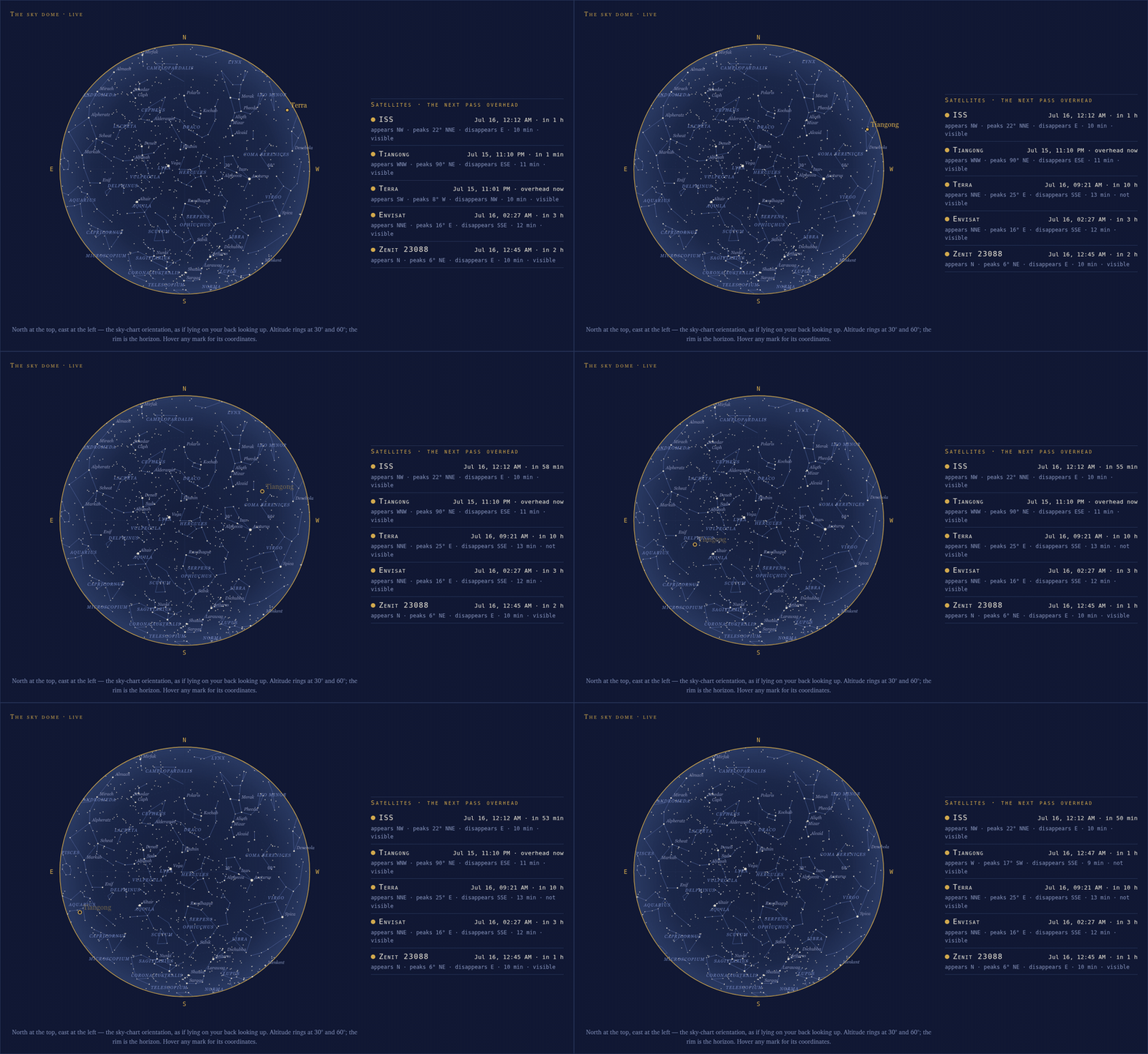
The animation is the weewx-celestial live page at work, moved by weewx-loopdata fields — weewx-skyfield’s own Sky page stays static, refreshing once per report cycle. The chart itself is this extension’s dome, embedded there. A third of the way across, still climbing, the marker inverts to a hollow ring as Tiangong — one of the two satellites the installer configures out of the box — slips into Earth’s shadow; it goes on to cross the exact center of the dome dark, no longer shining. In the opening seconds Terra is finishing its own low western pass: two satellites on the dome at once. 2-second frames played at 15 fps (about 30× speed), replayed through the live page with the orbital elements Space-Track archived for July 15.
Relationship to other extensions
- weewx-celestial (same author, 9.1 or later; 9.3 or later to use label layers) ships a live celestial page driven by weewx-loopdata almanac fields (see Live-updating pages above). Since celestial 6.0 it runs no service and computes nothing itself, so the two extensions coexist with no configuration — weewx-skyfield is the atlas, weewx-celestial the live instrument. (Only the historical celestial 3.x, which embedded this same almanac engine, needs
replace_builtin_almanac = falsein the[Celestial]section ofweewx.confwhen run alongside weewx-skyfield.) - weewx-skyfield-almanac (by a different author) is an independent Skyfield almanac extension with a different design (it downloads its ephemerides and catalogs at runtime). Choose one or the other; installing both would leave reports using whichever registered last.
Credits
weewx-skyfield stands on the work of others: Brandon Rhodes, author of the Skyfield astronomy library that performs every computation in this extension; NASA’s Jet Propulsion Laboratory (JPL), whose DE421 planetary ephemeris provides the positions of the sun, moon, and planets; the European Space Agency (ESA), whose Hipparcos mission produced the star catalog, and the CDS (Strasbourg astronomical Data Centre), which distributes it via VizieR; CelesTrak (T.S. Kelso), whose GP element service supplies the satellite orbital elements; the Minor Planet Center, whose CometEls.txt supplies the comet orbital elements; the International Meteor Organization (IMO), whose working list of visual meteor showers supplies the shower dates, radiants, ZHRs and parent bodies; the Stellarium project’s contributors, whose “modern” sky culture supplies the constellation stick figures; the International Astronomical Union (IAU) Working Group on Star Names, whose Catalog of Star Names supplies the named-star tags; the U.S. Naval Observatory (USNO) and Jean Meeus, whose published definitions and algorithms are the reference for rise/set, twilight, and other almanac conventions; and Tom Keffer, Matthew Wall, and the WeeWX project, whose almanac framework this extension plugs into. Gert Andersen contributed the Danish translation and Christian (peters77) reviewed the German. Jacques Terrettaz reviewed the French, suggested the dome’s constellation figures, and spotted that bright unnamed stars were leaving holes in them — which is why the dome now draws the complete catalog.
Licensing
weewx-skyfield is Copyright (C)2022-2026 by John A Kline and licensed under the GNU Public License v3. The bundled star catalog contains data from the Hipparcos and Tycho Catalogues, which ESA distributes under the CC BY-NC 3.0 IGO license. Credit: ESA. The bundled constellation figures are distilled from the Stellarium project’s “modern” sky culture, whose data is licensed CC BY-SA 4.0. Credit: the Stellarium contributors.